Fabrice.NEYRET
– Fabrice.Neyret@imag.fr
Maverick
team, LJK, at INRIA-Montbonnot (Grenoble)
Our goal fits within the general topic of the virtual exploration
of realistic galaxies, at all scales (cf our past collaboration
veRTIGE).
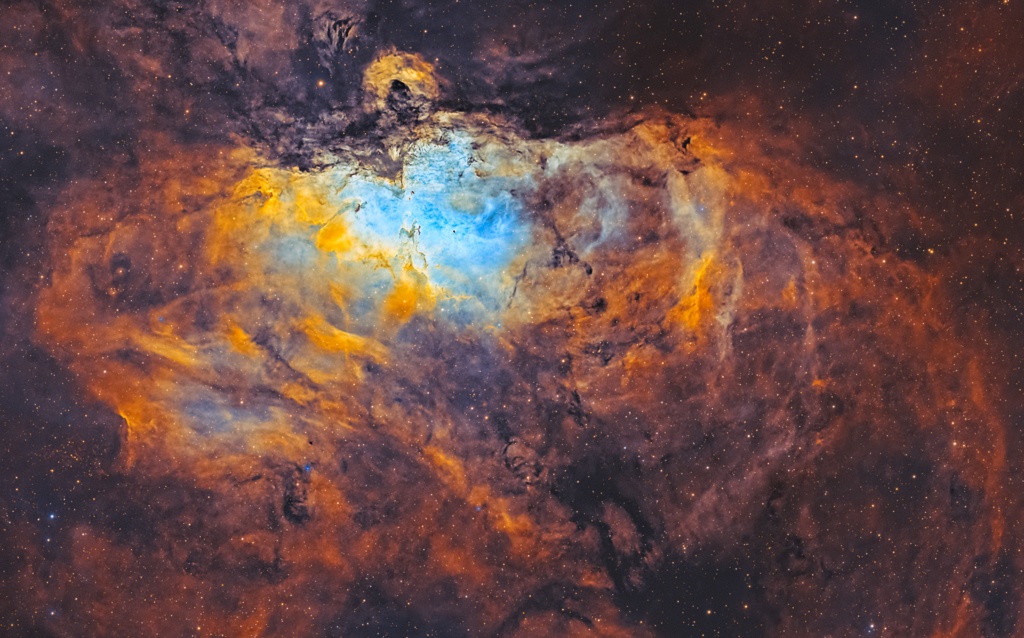
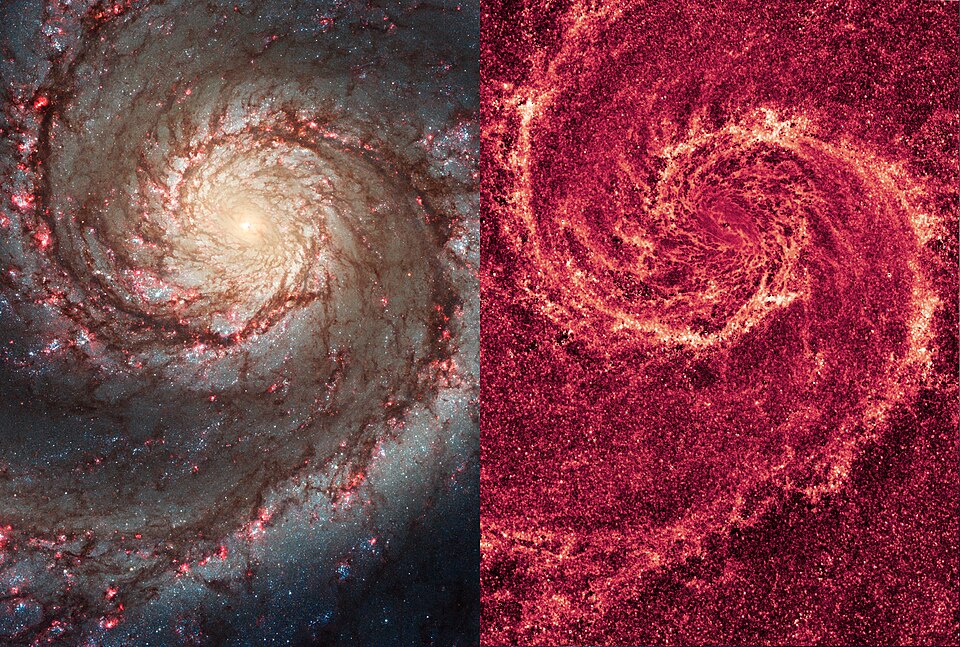
Hubble and JWST have popularized the incredibly detailed images
of astrophysical objects like spiral galaxies (e.g. M51)
and nebulae (e.g. Eagle),
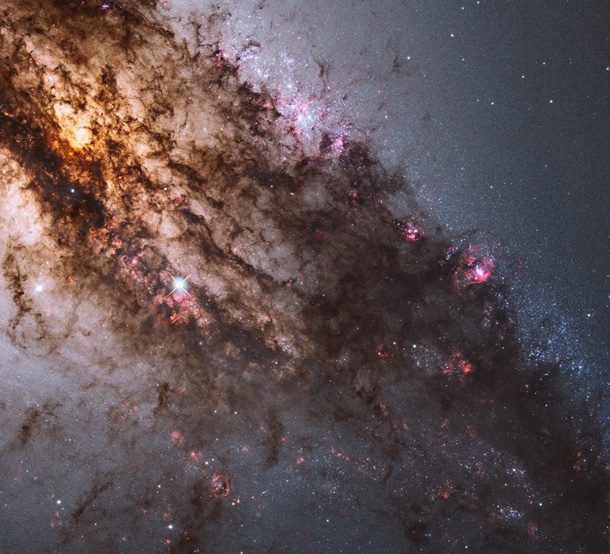
and astro-photography has exposed the details of the black
clouds of the MilkyWay
for even longer. Indeed, all the black part is a fractal continuum of
semi-opaque dust cloud (sometime locally illuminated) connecting all
the scales. Since this is the most structured and ubiquitous
ingredient for high resolution images, and its correct appearance is
crucial for realism, we set our goal as designing, generating and
rendering them.
Alas, almost no astrophysical models describe
the 3D textured aspect of the ISM - more generally, physics is more
interested in exact average quantities than pixel-precise
distribution of values in images - , so that the dust clouds are
mostly known by the 2D images mentioned above. Since very recently,
3D tomography obtained from Gaia
data is on the brinks of revolutionizing the field, but for now the
resolution and span are very limited, and the results suffer strong
artifacts.
Fortunately, graphist artists from movie production
and video games are used to imitate real-life content from reference
images by tuning parameters of shader trees based on procedural noise
like Perlin
noise, which is an efficient way to produce continuous fractal
stochastic fields. Alas, the generative space of Perlin noise is very
limited, especially for 3D distributions: the filament look of dust
clouds doesn't look like Perlin noise. Moreover, the ISM is
stochastic but it also have recognizable shapes, from nebulae bubbles
and pillars to the vast clouds (in which they are seamlessly
embedded) up to the galactic spirals and their multi-scale spurs:
anisotropy is everywhere, while it is an aspect mostly untackled with
in Computer Graphics. Finally, the virtual exploration of very deep
scenes requires LOD, but LOD of deep multiscale noise is not as
trivial as promised, especially because it is generally used together
with non-linear functions.
The goal of this PhD project is to
design new noise primitives able to better approach the typical
appearance of dust clouds, as well as data-structures and algorithms
able to manage the specification and realisation of anisotropic
distributions on an controlable way, in the scope of realtime flyover
in such wide and deep multiscale data, compatible with the limited
memory available on GPU.
We expect most of these results to
also be of use in the broader field of Computer Graphics.
- Some experience + general culture in Computer
Graphics ( realistic rendering, real-time rendering, proceduralism...
) / Maths / Physics of light,
- C/C++ , GLSL shading
language or equivalent ( programming involved ).